Quick answer: For two adults staying at one Palma base, price a car-free week first, then add rental days only where they materially improve your plans. Compare seven days of hire against three consecutive days—not just their daily rates. Include parking, fuel, collection costs, protection and authorised drivers. Keep refundable deposits outside your spending total.
In the illustrative calculation below: seven rental days cost €482.40, three rental days plus buses cost €372.80, and a bus-based alternative has a €74 planning allowance. These are calculation inputs, not available rental offers or verified itinerary-wide fares.
Research checked: 29 November 2026. All amounts are in euros. Provider terms and published transport information are snapshots, not promises for future travel dates.
1. Start with your base and the journeys you actually need
Before comparing cars, ask your accommodation four questions:
- Is parking available, reservable and included?
- If not, which car park should guests use, and what does the required duration cost?
- Can you legally drive to the entrance?
- How far is the actual room from useful bus stops?
Access and parking are separate questions. Palma’s municipal guidance provides an authorisation process for hotels within ACIRE restricted-access areas, while explicitly stating that this does not permit ORA street parking. Hotel Basilica’s own instructions illustrate the distinction: its guest access arrangements do not authorise parking on surrounding streets. This is a property-specific example, not a description of every Palma hotel. (mobipalma.mobi)
For a fixed Palma base, test three versions of your holiday:
| Option | What to test |
|---|---|
| Seven rental days | Will you use the car enough to justify keeping and parking it throughout? |
| Three consecutive rental days | Can you group car-dependent outings and return the vehicle before your city days? |
| No rental | Can you reach your chosen destinations and return comfortably using published services? |
The comparison should reflect your priorities. A bus-based holiday with fewer stops is not identical to a driving itinerary with several stops each day.
2. Build the rental total before comparing providers
Use this calculation:
Rental spending = final hire price + extras not already included + fuel + parking + collection/return transport.
Check whether taxes, location charges and selected protection are already included before adding anything again.
Airport-related costs differ by provider. SIXT’s published Spanish conditions say an airport, station or premium-location fee applies to the rental price and special services, with the applicable amount shown during booking. Hiper publishes a free airport shuttle arrangement rather than an in-terminal desk. Neither example establishes a universal Mallorca airport surcharge. (sixt.com)
Some published Hiper extras provide useful examples of how small daily charges accumulate:
| Extra | Published charge | Seven-day arithmetic |
|---|---|---|
| Additional driver | €5/day, maximum €100 | €35 |
| Baby seat | €5/day, maximum €40 | €35 per seat |
| Booster | €5/day, maximum €40 | €35 per booster |
| Mallorca collection between 23:00 and 01:00 | €40 | €40 if applicable |
These charges were checked on 29 November 2026; confirm the conditions attached to your booking. The two-adult example below includes no child seat. Families should obtain a quote for the correct restraint rather than treating it as an optional saving. (hiperrentacar.com)
Hiper also publishes a full-to-full fuel policy with a refundable fuel deposit. That means the fuel you consume belongs in spending; the refundable deposit belongs in your separate cash-availability calculation. (hiperrentacar.com)
For selected rental days, compare the exact collection and return times. Do not assume three calendar dates automatically produce three charged rental days.
3. Keep deposits, excess and spending in separate columns
Record three different figures before paying:
| Figure | What it means for your budget |
|---|---|
| Expected spending | Rental, chosen extras, fuel, parking and other planned charges |
| Refundable deposit or card hold | Money or credit capacity temporarily unavailable |
| Damage liability/excess | Potential exposure under the contract, including relevant exclusions |
SIXT’s deposit guidance explicitly distinguishes its authorisation from damage claims: the deposit secures outstanding contractual items, while the damage deductible depends on the protection selected. The exact authorisation belongs in your booking confirmation and agreement—not an island-wide estimate. (sixt.com)
Likewise, “no excess deposit” is not equivalent to “nothing can be charged.” Hiper’s FAQ lists exclusions from its included cover, including tyres, glass and certain other damage or misuse. Its conditions and FAQ also give different levels of detail about payment eligibility: the conditions request a credit card, while the FAQ describes a restricted cash/debit arrangement requiring a €1,000 deposit. Obtain written confirmation if relying on that arrangement. (hiperrentacar.com)
Practical checks:
- Ask for the exact hold, accepted card type and required cardholder name.
- Read what remains excluded after selecting protection.
- Confirm whether any separate cover reimburses you later rather than preventing an initial charge.
- Leave sufficient available funds for accommodation and ordinary spending.
Do not add a refundable hold to the holiday’s expected cost, and do not assume it caps every possible liability.
4. Price buses using the right payment method and timetable
Aena identifies EMT route A1 as the airport–Palma-centre service. Its linked operator pages should be checked for your arrival and departure times; this research could not extract a dependable current EMT fare from those JavaScript-based pages. The worked budget therefore uses an explicitly unverified airport-transfer allowance rather than presenting it as a fare. (aena.es)
For interurban travel, TIB publishes contactless bank-card fares and group discounts. Its instructions require validation on boarding and leaving; groups of up to five can use the same bank card. (tib.org)
For example, TIB’s published table shows a two-hop general-service journey costing €3.60 for the first passenger and €3.30 for the second passenger using the same card:
€3.60 + €3.30 = €6.90 one way, or €13.80 return for two adults.
This demonstrates the fare calculation; it does not establish the hop count for every excursion below. Check each stop pair in TIB’s planner. Airport-line fares have their own columns. (tib.org)
Do not automatically budget zero after reading about free transport: TIB’s 2026 announcement limits that arrangement to the specified transport cards; bank-card and single-ticket fares remain payable. (tib.org)
Also check:
- The timetable’s effective date and weekday/holiday column.
- The exact return stop and last suitable departure.
- Service notices and walking distance at both ends.
- Whether luggage or accessibility needs make the proposed journey workable.

5. Use this fixed-base itinerary to identify rental days
Here is a planning structure for two adults sharing one Palma accommodation, with no hotel changes. It is a sequence to adapt, not a confirmed timetable or parking reservation.
| Day | Proposed plan | Three-day-rental version |
|---|---|---|
| 1 | Arrive and settle into Palma | Airport bus; no car |
| 2 | Palma sightseeing | Walk and use local transport as needed |
| 3 | Valldemossa outing | TIB bus, subject to current timetable |
| 4 | Sóller or Port de Sóller | Collect rental car |
| 5 | Deià, with time left uncommitted | Keep car |
| 6 | Flexible outing chosen after checking access and parking | Return car within the booked period |
| 7 | Palma and preparation for departure | No car |
Schedule the airport return around your actual flight; an additional departure morning may fall outside these seven activity days.
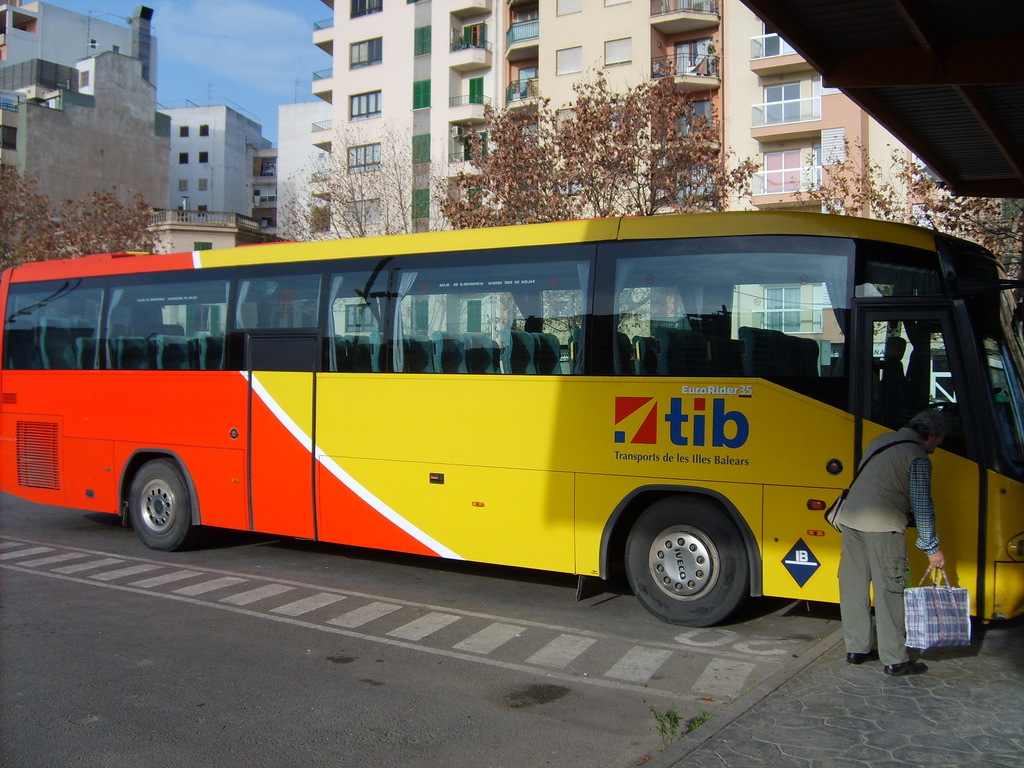
The bus-only version can substitute separate outings along the route 203 corridor for the driving days. TIB’s timetable effective 1 March 2026 connects Palma with Valldemossa, Deià, Sóller and Port de Sóller. It provides separate weekday and weekend/holiday tables. Treat that document as evidence of the published route structure, not confirmation of a departure for a later holiday. (tib.org)
For example, that timetable lists a weekday 09:45 departure from Palma reaching Valldemossa at 10:15, and a 15:45 return reaching Palma at 16:25. That illustrates a single-destination day with substantial visiting time; recheck the current timetable before using those times. (tib.org)
Avoid planning several villages, a beach and a late dinner as though every connection—or parking space—were guaranteed.

6. Worked example: seven rental days versus three or none
Illustrative planning period: 10–17 May 2027. Assume seven charged rental days for the full-hire option and three consecutive charged days for the shorter hire. Match actual pickup and return times when obtaining quotes.
Every figure below is an assumed calculation input, not a market-price estimate, live offer or prediction for May 2027.
Assumptions:
- Two adults, both authorised to drive; one small petrol car.
- Rental input: €30/day for seven days; €35/day for three days.
- Separate selected-protection input: €10/day.
- Additional-driver input: €5/day.
- Fuel model: 6 litres/100 km at an assumed €1.60/litre.
- Driving allowance: 400 km for full hire; 300 km for shorter hire.
- Base parking: €15 per retained night; seven nights versus two.
- Public transport allowances are provisional and must be replaced with route-specific fares.
| Spending item, two adults combined | Seven-day car | Three-day car + buses | Bus-based alternative |
|---|---|---|---|
| Rental | €210.00 | €105.00 | — |
| Separate protection allowance | €70.00 | €30.00 | — |
| Additional driver | €35.00 | €15.00 | — |
| Fuel | €38.40 | €28.80 | — |
| Base parking | €105.00 | €30.00 | — |
| Destination parking allowance | €24.00 | €18.00 | — |
| Airport/local/excursion transport allowances | €0.00 | €46.00 | €74.00 |
| Illustrative spending total | €482.40 | €372.80 | €74.00 |
The shorter-hire transport allowance comprises €20 for airport travel, €12 for local journeys and €14 for one excursion. The bus-based alternative uses €20, €12 and €42 respectively. These are placeholders, not verified itinerary totals.
Fuel arithmetic is:
400 km × 6 ÷ 100 × €1.60 = €38.40.
Under these assumptions, selected-day hire costs €109.60 less than keeping the car throughout. Removing base-parking charges changes that difference substantially: the totals become €377.40 and €342.80—a gap of only €34.60.
That is why your accommodation’s actual parking arrangements can matter more than a modest difference in the advertised daily rate.
7. Make the decision with a final booking check
Before choosing, replace every placeholder with a confirmed price or a clearly retained allowance.
Choose full-week hire if your actual journeys justify the extra spending, parking is workable and having the vehicle throughout solves a genuine practical need.
Choose selected days if you can group outings without repeated collection trips or inconvenient opening hours.
Choose public transport if the checked routes, walking distances and return services support the holiday you want.
For Palma parking, the municipality publishes time-limited ORA arrangements, including a two-hour maximum in Zone 1. Its page also announces an expansion from 1 January 2027. Do not carry a 2026 parking map into a 2027 booking without rechecking it, or treat short-stay street parking as an overnight solution. (mobipalma.mobi)
Finally, check cancellation deadlines, late-flight arrangements, return inspection procedures and existing damage before driving away. Keep photographs and fuel receipts.
The useful comparison is not “car versus bus” in the abstract. It is your confirmed rental total versus a transport plan that actually works from your accommodation.