Quick answer: Build your Japan spending plan in yen first, then divide unpaid yen expenses by your assumed number of yen per US dollar. Test a less favorable rate before booking. Keep settled dollar payments separate, add payment fees, and reserve money for unexpected costs. At payment terminals and ATMs, choosing JPY rather than a dollar-conversion offer avoids the provider’s dynamic currency conversion markup. Your own issuer’s fees may still apply. (visa.com)
Planning guide dated November 29, 2026. All exchange rates and trip amounts below are illustrative—not current exchange-rate quotes, accommodation offers or predictions. Published payment terms were checked for this guide; confirm your own account terms before traveling.
1. Build the spending plan in yen, not converted dollar estimates
Start with the currency in which each expense will actually be charged. For a hotel payable in Japanese yen, record its full JPY total—not just the dollar estimate displayed beside it.
Use a worksheet with these columns:
| Expense | Amount and charge currency | Payment date | Status | Fees or exclusions to check |
|---|---|---|---|---|
| Accommodation | Confirmed booking total | Now or at property | Paid/unpaid | Taxes, meals, cancellation terms |
| Transport | Fare for your actual route | Before or during travel | Paid/unpaid | Reservations, transfers, luggage |
| Daily spending | Your chosen JPY allowance | During travel | Unpaid | Food, admissions, shopping |
| Dollar-priced purchases | Confirmed USD total | As agreed | Paid/unpaid | Whether USD is the charge currency |
For each booking, ask: What currency will you charge, how much, and when? Treat a displayed dollar equivalent as an estimate unless the payment terms establish a dollar charge.
This distinction matters even when a yen price is fixed. The official Japan Rail Pass website, for example, says online purchases settle in yen and warns that the exchange rate when purchasing can differ from the rate when visiting Japan. That illustrates why booking date, payment date and travel date should not be treated as interchangeable. (sevenbank.co.jp)
Separate essential costs from optional spending. If the exchange rate becomes less favorable, reducing a shopping allowance is a different decision from finding enough money for an unpaid hotel bill.
2. Choose three exchange-rate assumptions
Write exchange rates consistently as JPY per USD.
Your basic calculation is:
Estimated USD cost = unpaid JPY amount ÷ JPY per USD
At an illustrative rate of ¥150 per $1, a ¥30,000 expense equals $200 before fees. At ¥130 per $1, the same expense equals approximately $230.77.
A lower number of yen per dollar means your dollars buy fewer yen.
Use three scenarios:
- Working rate: the assumption used for your main budget.
- Less favorable rate: a stress test showing whether essential spending still fits.
- More favorable rate: a comparison, not money to spend in advance.
For this guide, those assumptions are ¥150, ¥130 and ¥170 per US dollar. They are deliberately illustrative; they are not forecasts or claims about the current market.
Record the date and source of any real rate you use. Also distinguish a planning quote from the rate applied to an actual transaction. CFPB guidance notes that a card transaction’s conversion rate need not be the rate in effect on the purchase date. (consumerfinance.gov)
The useful question is not “Can I predict the yen?” It is “Does this itinerary remain affordable under my less favorable assumption?”

3. Worked example: the same trip at three rates
Consider a hypothetical trip for two adults sharing one room, with seven hotel nights and eight spending days in Japan.
These are invented planning allowances for demonstrating currency exposure—not researched estimates of what this itinerary should cost.
| Japan expense | Illustrative allowance |
|---|---|
| Accommodation: seven nights × ¥17,000, plus ¥1,000 deliberately allowed for rounding | ¥120,000 |
| Food: eight days × ¥8,000 for both adults | ¥64,000 |
| Intercity transport, airport transfers and local travel | ¥70,000 |
| Attractions and activities | ¥26,000 |
| Miscellaneous spending | ¥20,000 |
| Total yen budget | ¥300,000 |
For a real trip, replace every allowance with booking totals, route-specific fares or your own spending limits. Add any excluded taxes or compulsory charges.
If the full ¥300,000 remains unpaid:
| Illustrative rate | USD equivalent before payment fees |
|---|---|
| ¥130 per $1 | $2,307.69 |
| ¥150 per $1 | $2,000.00 |
| ¥170 per $1 | $1,764.71 |
Now suppose the travelers have already paid:
- $1,800 for flights, settled in USD.
- $800 for accommodation, the final posted dollar cost of the ¥120,000 hotel expense, including any applicable payment fees.
Only ¥180,000 remains unpaid.
| Illustrative rate | Unpaid ¥180,000 in USD | Total including $2,600 already paid |
|---|---|---|
| ¥130 per $1 | $1,384.62 | $3,984.62 |
| ¥150 per $1 | $1,200.00 | $3,800.00 |
| ¥170 per $1 | $1,058.82 | $3,658.82 |
These totals exclude fees on future payments and contingency money.
The practical lesson: apply new exchange-rate assumptions to the unpaid balance, not to money already spent. In this example, moving from ¥150 to ¥130 requires approximately $184.62 more, not a recalculation of the entire vacation.
4. Separate settled payments, unpaid bookings and yen already held
For planning purposes, use three categories:
Settled payments: Enter the actual posted USD amount. In the worked example, the hotel stays at $800 across all three scenarios because that payment has already settled.
Unpaid yen commitments: Keep the JPY amount and recalculate it under each scenario. A reservation confirmation is not proof that its dollar cost is fixed; check the charge currency and payment date.
Yen already acquired: Track both the yen available and the dollars actually spent obtaining it. Do not include the same yen again as money you still need to buy.
For a deposit-and-balance arrangement, split the booking into two lines. If ¥30,000 has been paid toward a ¥100,000 booking, the remaining currency exposure is ¥70,000.
Prepayment should not be treated as an automatic saving. Compare its total cost and cancellation conditions with the unpaid option. If cancellation is possible, ask what currency a refund would use and whether payment fees are refundable; do not assume the original dollar outlay is guaranteed back.
The worksheet’s purpose is to make those unknowns visible—not to replace the supplier’s terms.
5. Understand card conversion before accepting a dollar total
At a merchant terminal, you may be offered payment in yen or US dollars. The dollar option can be dynamic currency conversion, or DCC: the merchant’s payment provider converts the transaction rather than leaving it denominated in yen. Visa says that conversion usually includes a markup and advises choosing local currency to avoid it. (visa.com)
A practical checkout routine is:
- Check the original yen amount.
- Choose JPY/local currency if declining DCC.
- Confirm that the receipt records the currency you selected.
- Retain the receipt until you reconcile the posted charge.
Visa says a DCC offer should display both currency amounts, the exchange rate and additional fees or markup. The merchant or ATM should give you a choice rather than selecting conversion for you. (visa.com)
Declining DCC does not eliminate your issuer’s foreign transaction fee. Nor does accepting a USD charge necessarily avoid that fee: CFPB guidance explicitly includes fees on dollar transactions made outside the United States or with foreign merchants. (consumerfinance.gov)
For budgeting arithmetic, if your agreement charged a hypothetical 3% fee on a $200 converted purchase, allow another $6. Use your actual agreement—not that illustrative percentage.
6. Budget ATM withdrawals as several possible costs
Plan access to cash rather than assuming every purchase can go on a card. Japan’s national tourism organization says some small stores and guesthouses may accept only cash. (japan.travel)
Check separately for:
- The Japanese ATM operator’s charge.
- Your own bank’s withdrawal charge.
- Any international transaction or conversion fee.
- DCC, if you accept an ATM’s dollar-conversion offer.
As one published example—not a product recommendation—Bank of America’s international ATM page identifies a $5 non-Bank of America ATM usage fee and a 3% international transaction fee on the converted dollar amount. It describes partner-ATM arrangements and notes that the international transaction fee may be waived for certain account relationships. Those terms must not be generalized to other banks or every customer. (locators.bankofamerica.com)
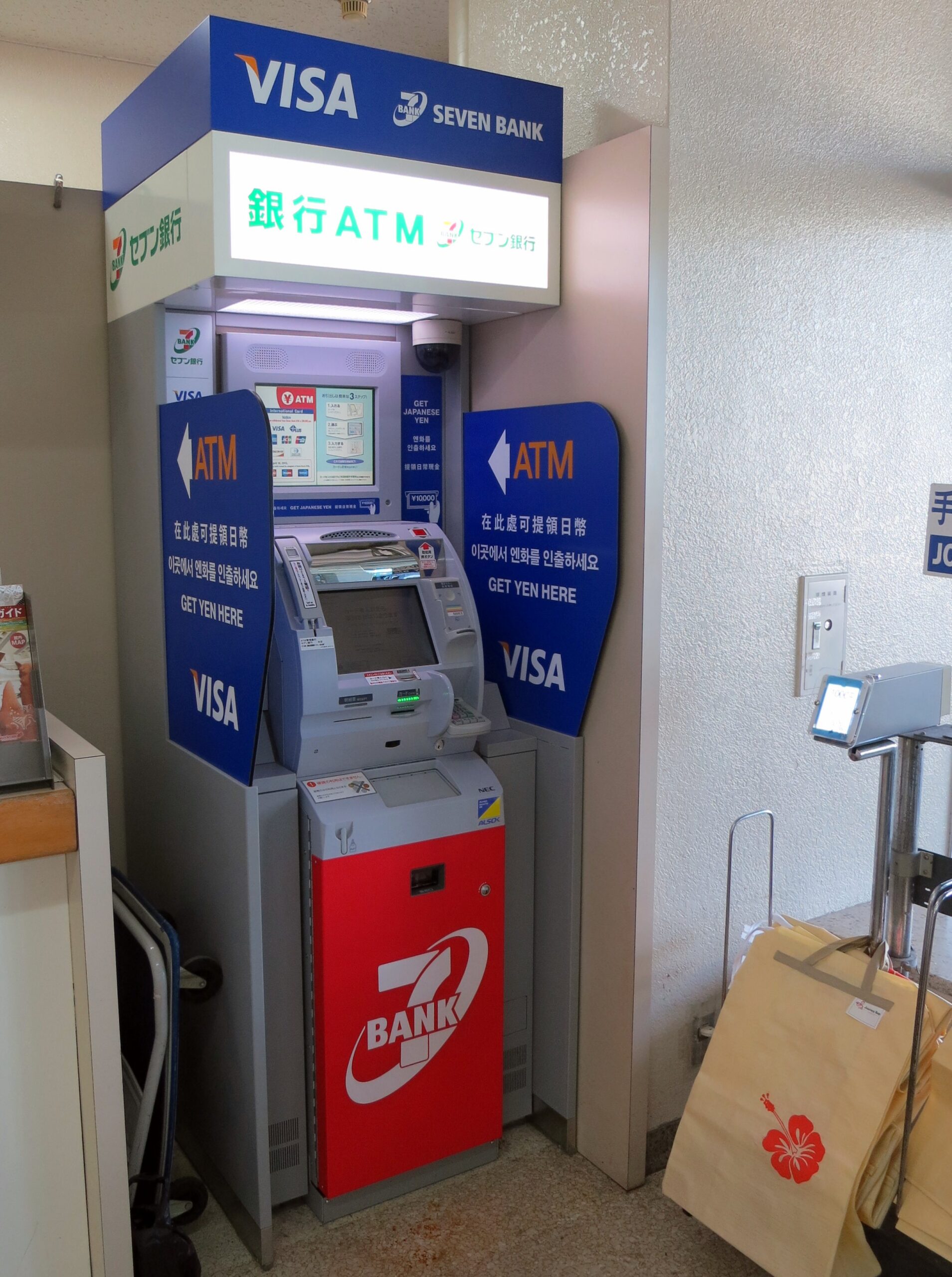
Seven Bank says withdrawals that incur service charges are charged by transaction count. It publishes a ¥100,000 per-withdrawal limit for overseas-issued cards, with a ¥30,000 limit for magnetic-stripe transactions. Your issuer’s own limit also needs checking. (sevenbank.co.jp)
Where a flat charge applies, repeated small withdrawals increase that component: four $5 charges total $20; two total $10. That arithmetic is not a reason to carry your entire holiday budget.
At the machine, read the fee and currency screens before confirming. Seven Bank distinguishes home-currency DCC from yen settlement; choosing yen leaves the home-currency amount to be determined later. (sevenbank.co.jp)

7. Keep contingency money separate and reconcile as you go
Create two reserves rather than one unexplained percentage.
Currency reserve: In the example, the less favorable scenario requires $184.62 more than the working-rate budget. Set that amount aside if you intend to preserve the same unpaid yen spending.
Disruption reserve: Choose an additional amount based on costs you might need to cover, such as an extra night or replacement transport. A hypothetical $150 reserve would bring the combined reserve to $334.62, but it would not guarantee coverage of a disruption.
Known payment fees belong in the main budget, not hidden inside contingency.
Before departure, check:
- Which bookings are truly paid and which remain payable.
- The charge currency and cancellation deadline for each unpaid booking.
- Your card and ATM fee schedules, PIN and withdrawal limits.
- A backup payment method and separately stored issuer contact details. JNTO recommends keeping issuer contact numbers apart from your cards. (japan.travel)
During the trip, reconcile posted charges and remaining yen commitments. Avoid counting a cash withdrawal as both an expense and the purchases later made with that cash: record the withdrawal as funding, its fees as expenses, and the purchases by category.
Your usable budget is settled dollar costs + remaining yen costs converted at your planning rate + known fees + separate reserves. That structure shows what has changed—and what you can adjust—without pretending to predict exchange rates.